We use cookies to ensure our site functions properly and to store limited information about your usage. You may give or withdraw consent at any time. To find out more, read our privacy policy and cookie policy.
Manage Cookies
A cookie is information stored on your computer by a website you visit. Cookies often store your settings for a website, such as your preferred language or location. This allows the site to present you with information customized to fit your needs. As per the GDPR law, companies need to get your explicit approval to collect your data. Some of these cookies are ‘strictly necessary’ to provide the basic functions of the website and can not be turned off, while others if present, have the option of being turned off. Learn more about our Privacy and Cookie policies. These can be managed also from our cookie policy page.
Strictly necessary cookies(always on):
Necessary for enabling core functionality. The website cannot function properly without these cookies. This cannot be turned off. e.g. Sign in, Language
Analytics cookies:
Analytical cookies help us to analyse user behaviour, mainly to see if the users are able to find and act on things that they are looking for. They allow us to recognise and count the number of visitors and to see how visitors move around our website when they are using it. Tools used: Google Analytics
Share Bus Reform Pilot on FacebookShare Bus Reform Pilot on X (formerly Twitter)Share Bus Reform Pilot on LinkedinEmail Bus Reform Pilot link
Cumbria has been selected by the Department for Transport as a Bus Reform Pilot Study area. This gives Cumberland Council and Westmorland and Furness Council the opportunity to explore potential new ways of planning, funding and delivering bus services together.
The purpose of the pilot is to assess whether bus reform could help improve public transport outcomes across Cumbria, recognising the challenges of delivering reliable and accessible services in a predominantly rural county. The study considers how the bus network can better support key council outcomes and priorities. The following draft desired outcomes for bus reform in Cumbria have been developed as part of this study, aligning with existing council outcomes:
Towards a Cumbrian bus network that provides reliable, affordable and attractive connections to jobs, education, services and amenities.
Towards a Cumbrian bus network that supports sustainable, resilient, diversified economic activity and development, supporting economic and social regeneration.
Towards a Cumbrian bus network that meets the needs of diverse groups of people.
Towards improved integration of the Cumbrian bus network with other public transport and with active modes.
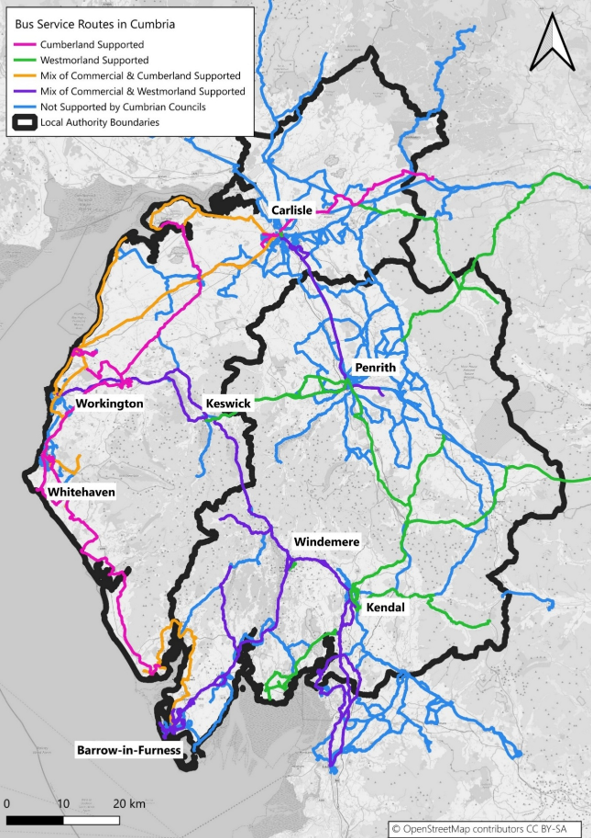
Figure 1: Map showing high level extents of the commercial and supported bus network in Cumbria.
NB1: ‘Supported’ route lines may only be subsidised at certain times of the day or week.
NB2: “Not supported by Cumbrian Councils” could mean they are commercially operated, or supported by neighbouring/cross-boundary authorities
Cumbria has been selected by the Department for Transport as a Bus Reform Pilot Study area. This gives Cumberland Council and Westmorland and Furness Council the opportunity to explore potential new ways of planning, funding and delivering bus services together.
The purpose of the pilot is to assess whether bus reform could help improve public transport outcomes across Cumbria, recognising the challenges of delivering reliable and accessible services in a predominantly rural county. The study considers how the bus network can better support key council outcomes and priorities. The following draft desired outcomes for bus reform in Cumbria have been developed as part of this study, aligning with existing council outcomes:
Towards a Cumbrian bus network that provides reliable, affordable and attractive connections to jobs, education, services and amenities.
Towards a Cumbrian bus network that supports sustainable, resilient, diversified economic activity and development, supporting economic and social regeneration.
Towards a Cumbrian bus network that meets the needs of diverse groups of people.
Towards improved integration of the Cumbrian bus network with other public transport and with active modes.
Share Department for Transport Bus Reform Pilot Survey on FacebookShare Department for Transport Bus Reform Pilot Survey on X (formerly Twitter)Share Department for Transport Bus Reform Pilot Survey on LinkedinEmail Department for Transport Bus Reform Pilot Survey link